
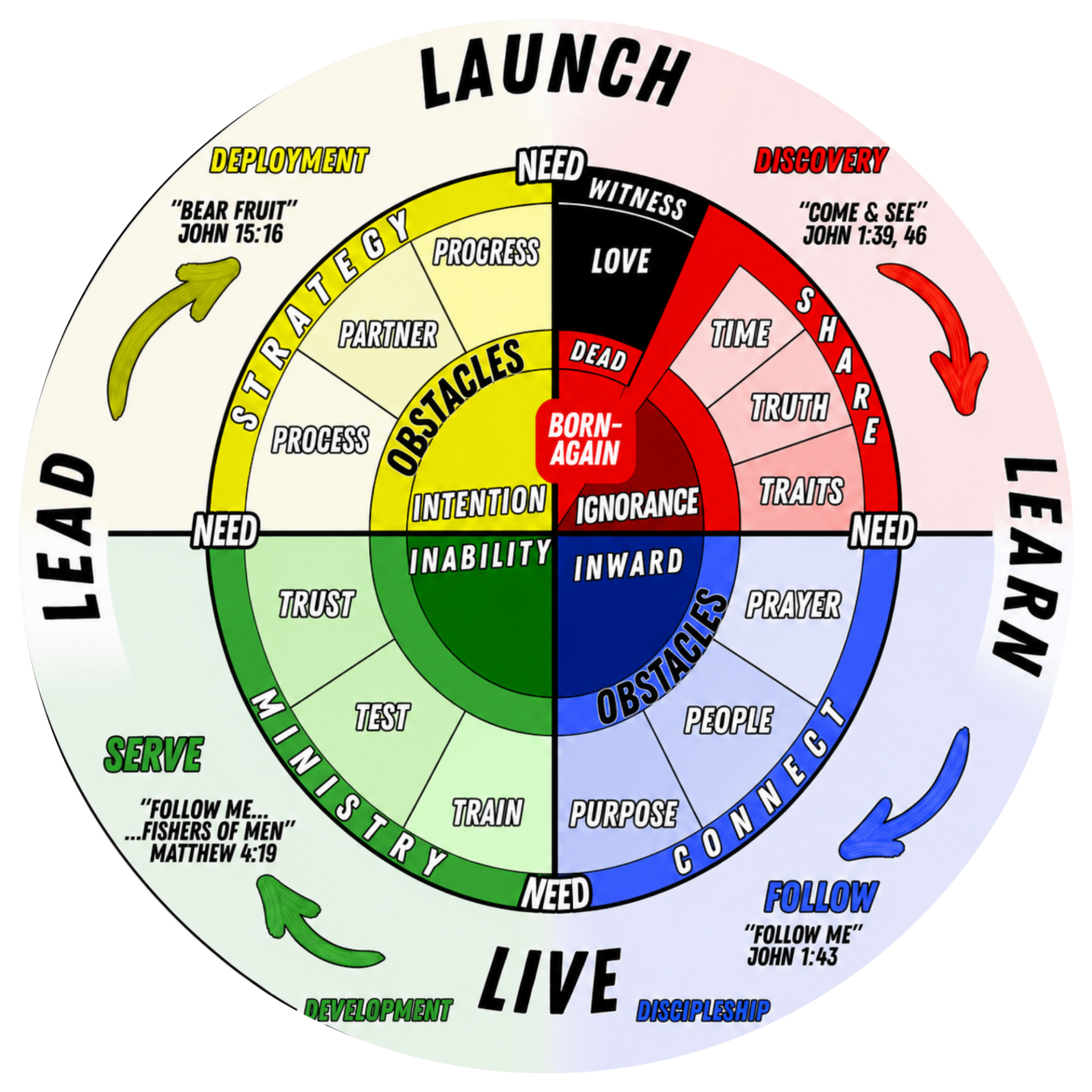
Come & See
Begin discovering who Jesus is and what it means to follow Him.
John 1:39, 46
CONNECT Bible Reading Method, Plan, & Journal
A guided daily path through Scripture paired with a reflection companion to help you engage with what God is teaching you.
Discipleship Pathway Assessment
A short assessment to identify where you are on the journey and what step comes next.
Follow Me
Develop healthy rhythms that help you grow in your relationship with Christ and His Church.
John 1:43
Spiritual Gifts Assessment
God has uniquely designed you for a purpose. Take this assessment to discover your spiritual gifts and explore how He has equipped you to serve others and strengthen His Church.
Disciple-Making Journey
Spend the next 40 days intentionally growing as a disciple who makes disciples. This guided journal combines Scripture, reflection, and practical action steps to help you develop a lifestyle of following Jesus and investing in others.
Connect Group Involvement
Find a small community for weekly encouragement, study, and prayer.
Join a Serve Team
Serving isn't about filling a spot. It's about joining God in what He's already doing, while growing as a disciple of Jesus. Find your place, today.
Learning to tell my STORY: A Testimony Guide
A simple framework to help you share your faith naturally. Use the STORY acronym to reflect on your search, turning point, ongoing change, reason for hope, and how to invite others to share their story.
A testimony is more than the story of how you came to Christ. It's the ongoing story of how Christ continues to meet you, change you, and give you hope. While your salvation story never changes, the part of your story you share may. As you listen to someone else's struggles, God may bring to mind a specific way He has been faithful in a similar situation. Your testimony isn't just about how Jesus saved you then; it's also about how He is saving, shaping, strengthening, and sustaining you today.
S — Search
What was I searching for before I met Jesus? Everyone is looking for something. Some are searching for acceptance. Others for success, security, purpose, peace, or significance. Before Christ, what was driving your life?
Ask yourself:
- What did my life revolve around?
- Where did I look for identity or security?
- What did I believe would satisfy me?
- What fear, hurt, or struggle shaped my life?
Example: “I spent years trying to prove my worth through success, but no matter what I accomplished, there was still something missing.”
T — Truth & Turning Point
What happened that got my attention, and what truth about Jesus changed everything? Most people don’t come to Christ without first realizing something is missing. Sometimes it is failure. Sometimes it is regret, loss, brokenness, guilt, or simply discovering that what we were chasing could never satisfy. That turning point prepares our hearts to hear the truth of the gospel.
Ask yourself:
- What happened that got my attention?
- When did I realize what I was searching for wasn’t enough?
- What regret, disappointment, or circumstance exposed my need?
- Who helped me understand the gospel?
- What truth about Jesus finally made sense?
- Why did I surrender my life to Him?
Example: “After my marriage began falling apart, I realized success couldn’t fix what was broken inside me. That’s when someone shared the gospel with me, and for the first time I understood that I could never earn God’s acceptance. Jesus had already done everything necessary through His death and resurrection.”
O — Ongoing Change
How is Jesus still changing me? Your testimony isn’t just about what happened then—it’s about what Jesus is doing now. No believer is perfect, but every believer should be changing.
Ask yourself:
- What has Christ changed in me?
- How do I think differently today?
- What motivates me now?
- How do I handle struggles differently than I used to?
Example: “Life still has challenges, but I don’t face them alone anymore. My identity is no longer found in what I do, but in who I am in Christ.”
R — Reason for Hope
Why do I have hope today? Peter tells us to always be ready to give a reason for the hope that is in us. This is the heart of your testimony. Why do you trust Jesus?
Ask yourself:
- Why do I trust Christ?
- What gives me peace today?
- What hope has He given me?
- How has following Jesus changed the way I face the future?
Example: “My hope isn’t that life will always be easy. My hope is that Jesus is with me now, and because of Him my future is secure forever.”
Y — Your Story
Now I’d love to hear yours. Your testimony shouldn’t end the conversation—it should begin one. After sharing your story, invite the other person to share theirs.
You might ask:
- Tell me about your spiritual journey.
- Have you ever thought much about Jesus?
- Where do you find hope when life gets hard?
- Has anyone ever explained the gospel to you?
- Would you mind if I shared a little more about what Jesus has done for all of us?
Fishers of Men
Move beyond learning into serving and practical ministry experience.
Matthew 4:19
The Leadership Cohort
An Eight-Week Leadership Practicum (with ongoing responsibilities and periodic check-ins) — Equipping Leaders to Help Others Establish Daily Rhythms.
Purpose
The Leadership Cohort exists to prepare faithful leaders who lead like Jesus. Through biblical instruction, practical ministry experience, intentional discussion, and guided reading, participants will develop the character, knowledge, and skills necessary to lead others with humility, conviction, and wisdom.
Rather than simply providing information, this practicum emphasizes formation. Participants will learn to handle God's Word accurately, shepherd people faithfully, facilitate biblical discussion, care for others, lead difficult conversations with grace and truth, and serve with humility. Every lesson is designed to move participants from learning about leadership to practicing biblical leadership.
The cohort combines Scripture, discussion, practical ministry assignments, and carefully selected readings to help participants grow as Christ-centered leaders at home, in the church, and in everyday life.
Goals
By the conclusion of the cohort, participants will be able to:
- Lead with the humility and character of Christ.
- Study and interpret Scripture accurately using the CONNECT Bible Study Method.
- Teach God's Word clearly and faithfully.
- Shepherd people with truth, compassion, and wisdom.
- Facilitate healthy biblical discussion in groups.
- Lead difficult conversations with grace and conviction.
- Serve others with humility rather than position.
- Discern and pursue their next step of leadership within the church.
- Demonstrate faithfulness in both character and ministry.
Weekly Topics
- Week 1 — Leadership Begins with Surrender: Christlike humility and servant leadership.
- Week 2 — Learning to Study Scripture: Learning the CONNECT Bible Study Method.
- Week 3 — Studying for Others: Teaching Scripture for transformation rather than information.
- Week 4 — Leading in Small Spaces: Facilitating healthy discussion and leading groups effectively.
- Week 5 — Caring for People: Shepherding people with compassion, truth, and intentional care.
- Week 6 — Directing and Confronting in Love: Leading difficult conversations with grace and truth.
- Week 7 — Serving with Strength and Joy: Leading through faithful service rather than position.
- Week 8 — Leadership Practicum and Assessment: Demonstrating biblical leadership in a practical ministry setting.
Expectations
Participants are expected to:
- Attend and actively participate each week.
- Complete all assigned Scripture reading and weekly reading assignments.
- Practice one ministry action each week.
- Complete assigned leadership exercises.
- Demonstrate teachability, humility, and faithfulness to Christ and His church.
- Invest approximately 1½ hours each week during the cohort meeting and approximately one additional hour in personal preparation and reading.
Required Reading
- Week 1 — J. Oswald Sanders, Spiritual Leadership (Chapters 1–2, 6, 14).
- Week 2 — Howard G. Hendricks & William D. Hendricks, Living by the Book (Chapters 1, 5, 20, 32).
- Week 3 — Andy Stanley & Lane Jones, Communicating for a Change (Chapters 1, 4, 5, 7).
- Week 4 — Reggie Joiner & Tom Shefchunas Cova, Lead Small (Introduction and Chapters 1–5).
- Week 5 — Edward T. Welch, Side by Side (Chapters 1, 2, 7, 13, 14); 9 Arts, The Art of Listening.
- Week 6 — Kerry Patterson, Joseph Grenny, Ron McMillan & Al Switzler, Crucial Conversations (Chapters 1–3); 9 Arts, The Art of Asking Questions.
- Week 7 — Bill Hybels, The Volunteer Revolution (Chapters 1–3, 9).
Recommended Reading
Handling Scripture and Teaching:
- Haddon Robinson, Biblical Preaching — Chapters 3, 5.
- J. Scott Duvall & J. Daniel Hays, Grasping God's Word — Chapters 1–3.
Shepherding and Soul Care:
- Paul David Tripp, Instruments in the Redeemer's Hands — Chapters 2, 6.
- Timothy Witmer, The Shepherd Leader — Chapters 4–6.
Leadership Formation:
- Peter Scazzero, The Emotionally Healthy Leader — Chapters 1, 4.
- Ruth Haley Barton, Strengthening the Soul of Your Leadership — Chapters 4, 8.
Final Practicum Projects
At the conclusion of the Leadership Cohort, each participant will complete two supervised practicums designed to move learning from the classroom into real ministry.
Practicum One: Teaching God's Word
Each participant will be assigned a biblical text and coached through the process of studying, preparing, and teaching that passage in an existing Bible class. Following that experience, each participant will be paired with an experienced teacher and given the opportunity to teach a lesson from an approved curriculum in a different ministry setting. Throughout the process, participants will receive coaching and constructive feedback designed to strengthen their ability to faithfully communicate God's Word.
The purpose of this practicum is not simply to evaluate teaching ability but to help participants discover whether God has gifted and called them to teach. Some may pursue opportunities as substitute or regular Bible teachers, while others may discover that their gifts are better suited to another area of leadership. Every participant will leave with greater clarity regarding how God has uniquely equipped them to serve His church.
Practicum Two: Community Mission Project
Participants will work together to identify an underserved demographic within the church's community and design a practical outreach that intentionally meets a real need while creating opportunities for meaningful gospel conversations and invitations into the life of the church.
The objective is not simply to complete a service project but to demonstrate the love of Christ in ways that open doors for ongoing relationships. A project might include hosting a single-parent car care clinic, providing practical assistance for senior adults, serving foster and adoptive families, or another outreach designed around the unique needs of the community.
Each participant will assume responsibility for leading a specific area of the project, allowing every member of the cohort to gain practical experience in planning, organizing, leading volunteers, and engaging people with the gospel. Success will not be measured merely by the quality of the event but by intentional gospel engagement, meaningful conversations, invitations into biblical community, and opportunities to begin lasting relationships.
Following the project, the cohort will participate in a guided debrief to evaluate both the ministry and the mission. Together they will celebrate what God accomplished, identify lessons learned, discuss ways the outreach could be improved, and consider how the church might continue serving that particular demographic. The ultimate goal is to move beyond a one-time event by asking, "How can our church continue helping these individuals feel seen, loved, cared for, and welcomed into our family of faith?"
Bear Fruit
Continue growing alongside other disciple-makers while investing in others.
John 15:16
The Forum: A Quarterly Discipleship Gathering
Deployment is the lifelong phase of the Discipleship Pathway in which a disciple-maker is actively discipling at least one person through the pathway while participating in The Forum for ongoing encouragement, accountability, and sharpening.
The Forum is the quarterly gathering for those actively serving in the Deployment phase of the Discipleship Pathway. Participation is reserved for those who have completed the Discovery, Discipleship, and Development phases and are actively discipling at least one person through the pathway. While the earlier phases establish biblical foundations, cultivate spiritual maturity, and prepare believers for ministry, Deployment is where disciple-making becomes a way of life. The Forum exists to encourage, equip, and strengthen those who are actively investing in others as they help people find and follow Jesus.
Disciple-making was never intended to be a solitary pursuit. Every disciple-maker experiences seasons of joy, challenge, uncertainty, and growth. Questions arise, relationships become difficult, and opportunities require wisdom and discernment. The Forum provides an environment where disciple-makers celebrate stories of life change, share breakthroughs and struggles, pray for one another and those they are discipling, and encourage one another to remain faithful. Together they sharpen one another through honest conversation, practical wisdom, and shared experience so that no disciple-maker serves alone.
The Forum also provides regular opportunities to renew vision and strengthen the disciple-making DNA of the church. Participants discuss effective approaches, exchange ideas and resources, and learn from one another's experiences while reinforcing the biblical convictions and philosophy that define our pathway. The Forum continually reminds us that disciple-making is not a program but the ongoing mission of every mature follower of Christ.
Finally, The Forum serves as a natural rhythm for evaluation and planning. Participants assess the health of their disciple-making relationships, identify where each disciple is progressing through the pathway, celebrate growth, discuss obstacles, and establish practical next steps before the next gathering. This rhythm keeps disciple-makers intentional, accountable, and aligned with the mission of helping people find and follow Jesus.
More than a quarterly meeting, The Forum is the ongoing investment that sustains the Deployment phase of the Discipleship Pathway. It is where disciple-makers gather to encourage one another, preserve the culture of disciple-making, and remain faithful to Christ's call to make disciples who make disciples.
Come Prepared to Contribute
Every participant should come prepared to contribute. Arrive ready to share one story of life change, breakthrough, question, or struggle from your disciple-making relationships. Also bring the name of at least one person you are currently discipling, along with a specific prayer request, so the group can pray together. The Forum is strongest when every disciple-maker comes ready to encourage, sharpen, and strengthen others.
The Forum Quarterly Agenda
- Welcome, Meal & Opening Prayer — 15 minutes
- Stories of Life Change & Celebration — 20 minutes
- Disciple-Maker Roundtable (breakthroughs, challenges, ideas, and discussion) — 35 minutes
- Vision Renewal & DNA Reinforcement — 15 minutes
- Evaluation & Next Steps (disciples, pathway progress, multiplication, and goals) — 20 minutes
- Prayer for Disciple-Makers and Disciples — 15 minutes